By at .

Spice Notes Archives - Silk Road Diary
browser icon
You are using an insecure version of your web browser. Please update your browser!
Using an outdated browser makes your computer unsafe. For a safer, faster, more enjoyable user experience, please update your browser today or try a newer browser.

Spice Notes

Gourmet Salts: The Spice Merchants’ Need-to-Know Basics!

Salt Offerings

Salt Offerings

“Salty” is one of the five basic flavors that the human palate can detect, along with sweet, sour, bitter, and “umami.” A baker might tell you that salt makes “sweet things, sweeter,” but more specifically, salt clarifies all flavors. The human mouth is saline, or salty, to begin with, so in order to begin to taste the more nuanced flavors in our food, the salt level in the food first has to match that in our mouth. The wisest of chefs know that the goal with a sprinkle of this prized mineral is not necessarily to achieve a salty flavor, but to elevate and complement all of the flavors in a dish. Here are a few of our favorite varieties, and what we find to be their best uses!

We love Alderwood Smoked Salt, arguably the most dramatic of our offerings. Fine grains of Pacific sea salt are cold-smoked over locally-harvested alder wood chips to achieve a charcoal grey color, and a distinctive smoky aroma and taste. Shop visitors consistently describe Alderwood Smoked Salt as a “campfire in a jar.” The spice team finds that Alderwood Smoked Salt makes meat dishes somehow “meatier,” and enhances grilled flavors both inside and out. We also love it on heartier vegetables like eggplant and squash.

Murray River Flake Salt is another shop favorite. This flaky, apricot-colored salt is harvested from a dry river bed in Australia. The flakes are delicate, and almost crispy when eaten whole. We love to bake with this salt, as it mostly dissolves easily, but often leaves just a smidge of crystal behind, so one stumbles upon a tiny bit of salt as they make their way through dense banana bread or peanut butter cookie.

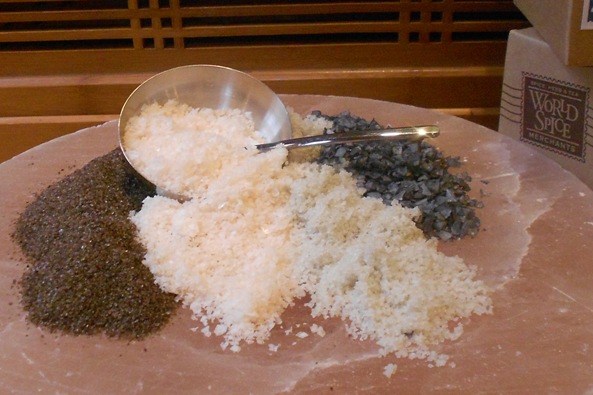
From left: Alderwood Smoked Salt, Murray River Flake Salt, Sel de Mer, Black Lava Flake Salt

From left: Alderwood Smoked Salt, Murray River Flake Salt, Sel de Mer, Black Lava Flake Salt

Sel de Mer, the aged scotch of salts! This French grey salt is light grey in color, and its medium-sized crystals tend to clump together with its high moisture content. The subtle flavor is deep and earthy, and is right at home atop fish of all kinds. We also prefer it over all others on our caprese salads, for the great contrast in texture between the crisp tomatoes, the creamy mozzarella, and the crunch of the salt, not to mention how well the heartiness of the flavor plays against the sweetness and acidity of the balsamic vinegar.

Black Lava Flake Salt is as delicious as it is visually intense. The pyramid-shaped crystals are black in color, rendered so because of natural charcoal deposits. This salt is best used as a finisher, as all of what makes it unique would be lost once dissolved. We like its assertive flavor sprinkled on slices of fresh cucumber seasoned with a dash of sweetened rice wine vinegar, as well as a whimsical addition to a fresh watermelon and mint salad- the crystals appear to be watermelon seeds at first glance!

As we often remind you, there are no wrong answers in food! (Well, okay, sometimes…) Any of these salts could lend a fun update to a standby dish. Salts are a wonderful way to break in to the world of experimental cooking and seasoning, and make a great gift for both the seasoned (yes, pun intended!) chef, and the novice foodie alike. Happy cooking!

Categories: Global Cuisines, Hot Topics, Notes from the Field, Spice Notes | Tags: , , , , | Leave a comment

Spice Lore

.

.

Historically speaking, spices have played a large part in the colonization of the world. Most of us remember from the fourth-grade pageant that Christopher Columbus sailed the ocean blue at the behest of Isabella and Ferdinand in search of black pepper, and that spices are what prompted Vasco de Gama to sail directly from Europe to India. But what of herbs and spices for the common folk?

Reflective of common concerns of the day, many ancient texts reference the properties of herbs and spices in protecting from the supernatural. Ancient Romans called basil “basiliscus” for its supposed ability to ward off a fearsome, dragon-like creature known as a basilisk, who could kill a person by looking at them. Dill was burned to clear clouds and stop thunder, or hung in bunches by the door to dissuade witches. If one had been struck by a spell, drinking dill water was considered a remedy. Marjoram was also considered a witchcraft inhibitor, while it was believed rosemary under the pillow kept the demons away.

Rosemary was also thought to be a memory enhancer, leading ancient Greek students to weave sprigs in to their hair during exams. Cinnamon was often used by psychics to increase vibrations and psychic awareness, along with lemongrass to increase abilities, and star anise to clear the mind, making it more receptive to visions. Saffron has historically been used to treat depression, while sage was reputed to make those who consumed it smarter.

Herbs and spices are also deeply rooted in romantic tradition. Basil, chamomileclovecoriander,  gingerjuniper, and lavender all have a place in love charms and potions used by the ancients. Medieval damsels embroidered the image of a flowering thyme sprig with a visiting bee on a kerchief as a gift for a favored knight. Sage has been used across many cultures to bring peace and domestic harmony to married couples, while rosemary is recorded as a symbol of enduring faithfulness. At traditional Persian weddings, a tray of seven multi-colored herbs and spices (Sini-ye Aatel-O-Baatel), including poppy seedssaltnigella seeds, and black tea,  are thought to guard the couple and their lives together against the “evil eye.”

Several of us spice merchants could use that rosemary memory enhancer, but for the most part, we find the culinary properties of our spices magical enough! We can’t comment on how effective any one of the above mentioned “treatments” are, but we can tell you that any one of our spices or blends can cure a terribly pervasive and common malady- that of bland food! What ever you use our wares for, though, we hope you do so in good health.

Categories: Hot Topics, Notes from the Field, Spice Notes | Tags: , , , | Leave a comment

Our Saffron Story

.

.

We have an enchanting story to share…it tells the tale about the very special saffron that comes to us from the folks at Fair Trade Morocco.

Fair Trade Morocco is a small importing business founded by Randy Thompson and Felicia Cain. While  volunteering with the Peace Corps in Morocco, Felicia and a fellow volunteer met with a local association that was interested in exporting the exquisite saffron grown in the Suktana region of Morocco.  Randy and Felicia  have collaborated with the saffron association and the community of Taliouine, Suktana, to provide the highest quality, sustainable product to the U.S. market.

The saffron is harvested in October and arrives in our store, not long after, personally delivered by two Peace Corps volunteers.  We get giddy over the beautiful, certified organic, aromatic threads.  We ooh and ahh, take zillions of photos, talk about saffron laden recipes, inhale the luscious bouquet and carefully place the saffron in 1 gram jars for our customers.

Oh yes, saffron is the most expensive spice in the world.  Always has been and probably will always be.  Here at the shop, we are often asked about the price of our saffron by the ounce. We normally sell it in smaller quantities, by the gram, and the staff was shocked to realize that it would cost $520 for just one ounce!

The beautiful yellow, orange, and red stigmas from the small purple saffron crocus must be handpicked from the center of the flower, each crocus provides only three stigmas and it takes 14,000 stigmas to yield one ounce of saffron. It can take 40 hours of picking, a full work week, just to pick a couple pounds. Luckily, one gram is more than enough to enjoy this exotic spice.

The golden threads of saffron infuse both an elegant flavor and a golden color into recipes. Saffron is part of the culinary culture in many different regions of the world. In India saffron is an indispensable ingredient in many recipes of rice, sweets and ice-creams. It is also used in Ayurvedic medicine and in religious rituals. In Saudi Arabia, a real Arabic coffee should have saffron and cardamom. In northern Italy and southern Switzerland, saffron is essential in the preparation of a traditional Risotto. In Sweden it is a traditional to bake saffron bread on the day of St. Lucile. Bouillabaisse, a fish stew from Provence in France, is traditionally served with a saffron broth. Finally, in Spain saffron is an indispensable ingredient in such famous dishes as Paella, Fabada or Pote Gallego.

That’s our Saffron Story…..we hope you enjoy both the story and the saffron as much as we do.

Categories: Hot Topics, Notes from the Field, Spice Notes | Tags: , , | Leave a comment

Spice and Tea Dyed Easter Eggs

Easter can be the time for pastel-dyed confections, day-glo-hued eggs, baskets filled with cheap, plastic toys, waxy chocolate, and dapper-dressed rabbits  intent on stuffing you with all of the above… unless you’re World Spice! We’re big believers in featuring the earth’s natural gifts, and with a host of spices and teas to choose from, we decided try our hand at the season’s chosen craft of dyeing eggs.  What resulted were beautifully dappled eggs in a rainbow of subtle spicy hues. Below are our favorites, and a bit of our process, too!

.

.

The vibrant yellow you see, is of course, from turmeric. The pinkish color is from beet powder, which we expected to make a more intense color, but instead came out as closer to a dusty rose. Hibiscus flower tea made the periwinkle color right in the middle, but combining beet powder and hibiscus made the intense indigo up in the left-hand corner. The hibiscus was so intense that if another of our experiments didn’t work, we soaked them in the hibiscus after, and came up with all sorts of odd colors, some even close to black!

.

.

We used white vinegar for our mordant, but you can use cream of tartar, as well. Distilled water works better than tap for dyeing, too. We were less than scientific in our measurements, but a good ratio is two tablespoons of mordant per four cups of water, and about a half cup of dyestuff. Bring mordant and water to a boil with your spice or tea to dye, turn off the heat, and allow the eggs to soak for at least half an hour, but in the fridge as long as overnight for the best results.

.

.

To make designs on your spice and tea dyed eggs, you can draw on the shells with beeswax prior to dyeing, or wrap the egg in rubber bands for a fun batik effect. To increase the dappled look, marbleize your egg by adding a drop of oil to the dye liquid. If you prefer a smoother look, strain the dyeing liquid before soaking the eggs. Which ever you do, be sure not to stir or shake up the eggs when they’re soaking, or you’ll disturb the setting of the mordant, and they won’t color as deeply. Happy Easter from the World Spice team!


Categories: Holiday, Hot Topics, North America, Notes from the Field, Spice Notes | Tags: , , , , , , , , | Leave a comment

Spice, Tea, and… Romance??

Sanjay and Pooja's Adorable Wedding Favor!

Sanjay and Pooja’s Adorable Wedding Favor!

The spice shop is a special place for many of us, staff and customers alike. For two decades we’ve swapped stories of favorite recipes and moments shared, but recently we heard a story that touched us like no other.

Meet Pooja, and her groom-to-be, Sanjay. They first found each other on an online dating site, but when discussing a place to meet in person, Sanjay suggested World Spice. On the 15th of January, 2012 the couple met for the first time right here in our shop, and spent the afternoon sharing  stories about spices and favored dishes. For the couples’ second date, Pooja prepared a pumpkin coconut curry and Harissa shrimp, and they realized a mutual love of ethnic foods, and big flavors. “We feel lucky to have found each other,” Pooja told us. Fast forward to February of 2013, and the happy couple is preparing to marry, still eating together, and when their busy schedules allow, cooking meals like grilled Tandoori chicken with roasted onions and peppers, and spicy burgers with sweet potato fries.

Pooja and Sanjay

Pooja and Sanjay

Herbs and spices are deeply rooted in romantic tradition. Giving gifts of spices for weddings is still very much alive. In modern times, spices can symbolize a fresh start. Pooja and Sanjay are giving away small tins of Indian Garam Masala to the friends and family who are sharing their special day. Congratulations, Pooja and Sanjay, we wish you a long and happy life together, full of love, spice, passion, and good food!

Categories: Holiday, Hot Topics, Spice Notes | Tags: , , , | 1 Comment

Roasted Quail Feast for Valentines Day

Exotic, aromatic and romantic we prepared this intimate feast with a table for two in mind. Succulent quail are roasted to perfection with one of our most alchemical blends: Ras el Hanout, which contains a hint of Moroccan rose petals and finished with a finger licking honey glaze.  Our  Wild Rice Pilaf accompaniment features the bold, classic flavor of cassia cinnamon while the  Paradise Pistachio Relish combines grains of paradise and Aleppo to bring everything together for a memorable Valentine’s Day Feast, we’ll leave the desert up to you. 

Honey Roasted Quail

Honey Roasted Quail with Wild Rice Pilaf and Paradise Pistachio Relish


Honey Glazed Roasted Quail

Ingredients

For the Quail Brine
1/2 gallon water
Ice, about 2 quarts
1/2 cup kosher salt
1/2 cup brown sugar
10 long Pepper, whole
3 tablespoons Indian coriander, whole
2 tablespoons allspice berries, whole
2 tablespoons rose petals
Peel from one lemon
For Roasting
1 tablespoon Ras el Hanout
4 tablespoons unsalted butter
2 tablespoons rose petals
For the Honey Glaze
3/4 cup honey
2 teaspoons Indian coriander, whole

Instructions

  1. For the Brine - Bring water to a boil in a large stock pot.
  2. Once boiled, remove from heat and add sugar and salt.
  3. Stir until sugar and salt have dissolved.
  4. Add enough ice to bring water volume to 1 gallon
  5. Once the brine has cooled, add quail and spices and refrigerate for 2 1/2 hours
  6. Preheat over to 450 degrees
  7. Remove quail from brine and pat dry with paper towels Set aside to bring to room temperature, about 30-40 minutes
  8. While quail are setting, melt butter in a small skillet
  9. Add Ras el Hanout, whisk and remove from heat
  10. Apply butter/Ras el Hanout mixture liberally to quail
  11. Roast quail, preferably on a grill rack, for 12-17 minutes
  12. While the quail roasts, prepare the glaze:
  13. In a small saucepan, heat honey and coriander over medium heat, stirring often, until honey is reduced by half, about 8 minutes
  14. Discard coriander seeds
  15. With a pastry brush, glaze the roasted quail with honey.
  16. Finish with Sel de Mer
  17. Serve with rice pilaf and pistachio relish (recipes below)
http://www.silkroaddiary.com/honey-glazed-roasted-quail/

 
Wild Rice Pilaf

Ingredients

1 cup wild rice
3-3 1/2 cups chicken or vegetable stock
1/2 medium yellow onion
2 cloves garlic, diced
4 tablespoons dates, chopped
2 tablespoons olive oil

Instructions

  1. In a small saucepan, brink stock to boil
  2. Add rice, cinnamon stick and bay leaf
  3. Reduce heat and simmer until rice kernels open, about 45-50 minutes
  4. While rice cooks, saute onion on medium heat until lightly browned, about 10 minutes
  5. Add garlic to onions and continue sauteing until garlic is lightly browned
  6. When rice is nearly cooked, add onion/garlic mixture, and dates
  7. Cover and until the dates have dehydrated, about 10 minutes
  8. Season with salt to taste
http://www.silkroaddiary.com/honey-glazed-roasted-quail/

 
Paradise Pistachio Relish

Ingredients

1 cup shelled, unsalted pistachios, toasted and roughly crushed (use the bottom of a bowl)
3 tablespoons flat leaf parsley, chopped
3 tablespoons fresh mint, chopped
1 clove garlic, crushed
Zest and juice of 1 lemon
2/3 cup extra virgin olive oil
1 tablespoon Aleppo pepper flakes
1 teaspoon grains of paradise, ground
Salt to taste

Instructions

  1. Combine pistachios, parsley, mint, garlic and lemon in a mixing bowl
  2. Slowly add olive oil, mixing as you go
  3. Add Aleppo, grains of paradise and salt
  4. Cover and allow to sit at room temperature for 1 hour
http://www.silkroaddiary.com/honey-glazed-roasted-quail/

Categories: Global Cuisines, Holiday, Main Meals, Middle East, North America, Recipes, Sides, Spice Notes | Tags: , , , , | Leave a comment

Piment d’Espelette

espelettehouseok2

.

Spice merchant Christmas is coming a little late this year, but it is well worth the wait! The current crop of Piment d’Espelette has arrived at our doorstep, ready to transform our soups, stews, rice pilafs, and most especially egg and fish dishes with its mild heat, and fruity, almost tomato-like flavor. A single sampling of this precious spice leaves no question as to why we are so excited by its arrival!

Piment d’Espelette (pepper of Espelette) originates in the area that joins the southwestern-most corner of France with northeastern Spain, a region historically known as Basque country. Piment d’ Espelette bears the distinction of being the only spice recognized by the AOC, or Appellation d’Origine Contrôlée. The AOC guarantees that products which bear its seal will be produced in traditional manners, and originate only from their traditional region (Champagne is a classic example). Therefore, only the superior pepper grown in the ten, tiny approved Basque villages may be labeled “Piment d’Espelette.”

Visits to this picturesque region in late summer and early fall yield visions of festoons of peppers, drying against white stucco houses as they have for centuries. Each October, the end of the Piment d’Espelette harvest is marked by a vibrant festival, complete with parade, that draws upwards of 20,000 tourists. There, the peppers are sold fresh, pickled, or dried and ground, as we carry it. At only 4,000 on the Scoville scale (as compared to 40,000 for Indian Cayenne), Piment d’Espelette’s mild flavor is the cornerstone of the traditional Basque stew piperade, a piquant concoction of peppers, tomatoes, onions, and on occasion, ham and eggs.

.

.

In keeping with Basque tradition, we consume our Piment d’Espelette seasonally; making way for the new crop when it comes. The Basque have another tradition worth imitating- that of the txoko, or gastronomical society. Generations of Basques have gotten together to cook, sing, and experiment with food in thousands of private clubs.  Pick up some of the freshest and most flavorful flakes of Piment d’Espelette available in the United States by the ounce, or sweetly packaged in a 1/2 ounce jar for your next txoko, or meeting of your foodie friends. On egin!

.

.

Categories: French, Hot Topics, Mediterranean, Notes from the Field, Spice Notes | Tags: , , , | Leave a comment

More Than a Minute for Chai…

.

The trains of India are legendary- they wind through the vast countryside and into the crowded cities, packing in locals and adventurers alike. Merchants selling traditional tea beverages- or chai wallahs- announce their wares at every stop, circulating through the cars to provide passengers with cups of steaming brew in low-fired clay cups (that you throw out the window when you’re finished!), jumping from the train as it pulls away from the platform.

Chai is such an integral part of the Indian culture that even if you’re miles away from food or potable water, there will always be someone to give you a hot cup of chai. The classic version is an aromatic brew centered around a black tea base, flavored with spices, and tempered with milk and a sweetener. Traditional chai beverages are brewed with different proportions of  warm, sweet spices such as ginger, cardamom, cinnamon and clove.

World Spice offers a variety of original chai blends to suit most any palate. Our most popular Sweet Chai is most traditional, with a little orange peel added for a full, aromatic flavor. Our Roast Chai makes use of deeply toasted spices to produce a sumptuous brew reminiscent of cocoa- and is also fabulous infused in to alcohols, or ground and used in desserts. Northwest Chai is our Puget Sound twist on the chai theme, using sage to pay homage to the wild sage that grows in the Cascade foothills here. Our Chipotle Chai is the chile-heads’ dream- flavorful, smoky, and spicy. The heat of the chile warms from the inside-out, no matter how frigid the drizzle.

We like to brew chai in a 16 oz. french-press pot, because it allows us to steep in two stages, getting maximum flavor from the spices while preventing the tea from becoming bitter. Add two tablespoons (or more!) of freshly cracked chai spice, and fill the pot half way with boiling water. After steeping for three minutes, add two tablespoons of black tea- our favorite is Assam- and top off the pot with more boiling water. Steep another three minutes, press, then add warm milk and honey to taste. Feel free to adjust the spice to tea ratio for a perfect personalized cup. If you’re accustomed to processed, syrupy chai concentrates, this process will be a revelation. Though a bit more of a time investment, you’ll find the reward well worth the effort- both for the steamy and fragrant amber brew, and for those few minutes you’ll learn to delight in taking for yourself.

Categories: Hot Topics, Indian Subcontinent, Notes from the Field, Spice Notes, Sweet Somethings, Wet Your Whistle | Tags: , , , , , | 1 Comment

A Celebration of Spices….The World Spice Team In Action

Well, we’re playing with food once again! A gathering of chefs, spice merchants, photographers and professional tasters (that’s me!) creating some delicious spicecentric recipes. Planning this testing has been so much fun because many of the recipes are geared towards the upcoming holidays. At our planning meetings, we shared stories of holiday food memories some of which were downright hysterical, other amazing, but without exception, all were remembrances of celebratory moments. From these stories (and meetings!) we have formulated several delectables for Halloween, Thanksgiving, Christmas, Hanukkah, Kwanzaa and more. There is a whole lotta love and joy in theses recipes and we hope you, your friends and family enjoy them as much as we have.

Chefs at Work

Three Chefs: Angelina, Robert and Sherrie


Categories: Notes from the Field, Spice Notes | Tags: , , , , , | Leave a comment

Fennel Pollen: Fad or Fabulous?

.

We spice merchants can be somewhat skeptical of the latest culinary fad, so it was with a fair degree of cynicism that we greeted our first shipment of fennel pollen. However, once we tasted this particular pollen, sourced from wild fennel plants on the hills of California, we were enthusiastic converts.

The particles are sunshine yellow in color, with a texture between fluffy and sandy. When eaten, the fennel intensity is unmatched, and comes in tandem with a candy sweetness- pungent, yet still somehow elusive. Much like pairing wines with food, different flavor nuances arise as the pollen is paired with different dishes. Curry notes, licorice tones, or the flavor of dark, muscovado sugar crystals have all been reported by our flavor experts here in the shop.

To harvest fennel pollen is a labor-intensive pursuit, so much like saffron, this means even a tiny amount is expensive. Each fennel flower yields only about a quarter teaspoon of precious pollen, and if that weren’t enough, the drying process is also tedious and finicky, requiring years of experience to master and perfect.

For as exotic as fennel pollen is, it’s surprisingly easy to use. Plan on about a pinch per serving, and use it to garnish foods just before serving. A cream-based vegetable soup, like Jerusalem artichoke or sunchoke, would be transformed by a dusting of fennel pollen and a sprinkle of coarse salt, or a common potato or leek gratin could be made extraordinary with just a touch. The spice team is ever experimenting, so stay tuned for unique recipes to utilize this rare and exciting ingredient!

Categories: Hot Topics, Notes from the Field, Spice Notes | Tags: , , | Leave a comment