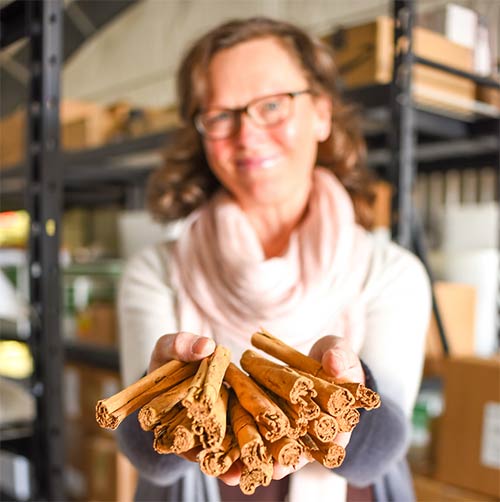
About World Spice Merchants
Find more about me on:

Here are my most recent posts

World Spice Merchants - Author at Silk Road Diary
browser icon
You are using an insecure version of your web browser. Please update your browser!
Using an outdated browser makes your computer unsafe. For a safer, faster, more enjoyable user experience, please update your browser today or try a newer browser.

Author Archives: World Spice Merchants

Spice, Tea, and… Romance??

Sanjay and Pooja's Adorable Wedding Favor!

Sanjay and Pooja’s Adorable Wedding Favor!

The spice shop is a special place for many of us, staff and customers alike. For two decades we’ve swapped stories of favorite recipes and moments shared, but recently we heard a story that touched us like no other.

Meet Pooja, and her groom-to-be, Sanjay. They first found each other on an online dating site, but when discussing a place to meet in person, Sanjay suggested World Spice. On the 15th of January, 2012 the couple met for the first time right here in our shop, and spent the afternoon sharing  stories about spices and favored dishes. For the couples’ second date, Pooja prepared a pumpkin coconut curry and Harissa shrimp, and they realized a mutual love of ethnic foods, and big flavors. “We feel lucky to have found each other,” Pooja told us. Fast forward to February of 2013, and the happy couple is preparing to marry, still eating together, and when their busy schedules allow, cooking meals like grilled Tandoori chicken with roasted onions and peppers, and spicy burgers with sweet potato fries.

Pooja and Sanjay

Pooja and Sanjay

Herbs and spices are deeply rooted in romantic tradition. Giving gifts of spices for weddings is still very much alive. In modern times, spices can symbolize a fresh start. Pooja and Sanjay are giving away small tins of Indian Garam Masala to the friends and family who are sharing their special day. Congratulations, Pooja and Sanjay, we wish you a long and happy life together, full of love, spice, passion, and good food!

Categories: Holiday, Hot Topics, Spice Notes | Tags: , , , | 1 Comment

Piment d’Espelette

espelettehouseok2

.

Spice merchant Christmas is coming a little late this year, but it is well worth the wait! The current crop of Piment d’Espelette has arrived at our doorstep, ready to transform our soups, stews, rice pilafs, and most especially egg and fish dishes with its mild heat, and fruity, almost tomato-like flavor. A single sampling of this precious spice leaves no question as to why we are so excited by its arrival!

Piment d’Espelette (pepper of Espelette) originates in the area that joins the southwestern-most corner of France with northeastern Spain, a region historically known as Basque country. Piment d’ Espelette bears the distinction of being the only spice recognized by the AOC, or Appellation d’Origine Contrôlée. The AOC guarantees that products which bear its seal will be produced in traditional manners, and originate only from their traditional region (Champagne is a classic example). Therefore, only the superior pepper grown in the ten, tiny approved Basque villages may be labeled “Piment d’Espelette.”

Visits to this picturesque region in late summer and early fall yield visions of festoons of peppers, drying against white stucco houses as they have for centuries. Each October, the end of the Piment d’Espelette harvest is marked by a vibrant festival, complete with parade, that draws upwards of 20,000 tourists. There, the peppers are sold fresh, pickled, or dried and ground, as we carry it. At only 4,000 on the Scoville scale (as compared to 40,000 for Indian Cayenne), Piment d’Espelette’s mild flavor is the cornerstone of the traditional Basque stew piperade, a piquant concoction of peppers, tomatoes, onions, and on occasion, ham and eggs.

.

.

In keeping with Basque tradition, we consume our Piment d’Espelette seasonally; making way for the new crop when it comes. The Basque have another tradition worth imitating- that of the txoko, or gastronomical society. Generations of Basques have gotten together to cook, sing, and experiment with food in thousands of private clubs.  Pick up some of the freshest and most flavorful flakes of Piment d’Espelette available in the United States by the ounce, or sweetly packaged in a 1/2 ounce jar for your next txoko, or meeting of your foodie friends. On egin!

.

.

Categories: French, Hot Topics, Mediterranean, Notes from the Field, Spice Notes | Tags: , , , | Leave a comment

More Than a Minute for Chai…

.

The trains of India are legendary- they wind through the vast countryside and into the crowded cities, packing in locals and adventurers alike. Merchants selling traditional tea beverages- or chai wallahs- announce their wares at every stop, circulating through the cars to provide passengers with cups of steaming brew in low-fired clay cups (that you throw out the window when you’re finished!), jumping from the train as it pulls away from the platform.

Chai is such an integral part of the Indian culture that even if you’re miles away from food or potable water, there will always be someone to give you a hot cup of chai. The classic version is an aromatic brew centered around a black tea base, flavored with spices, and tempered with milk and a sweetener. Traditional chai beverages are brewed with different proportions of  warm, sweet spices such as ginger, cardamom, cinnamon and clove.

World Spice offers a variety of original chai blends to suit most any palate. Our most popular Sweet Chai is most traditional, with a little orange peel added for a full, aromatic flavor. Our Roast Chai makes use of deeply toasted spices to produce a sumptuous brew reminiscent of cocoa- and is also fabulous infused in to alcohols, or ground and used in desserts. Northwest Chai is our Puget Sound twist on the chai theme, using sage to pay homage to the wild sage that grows in the Cascade foothills here. Our Chipotle Chai is the chile-heads’ dream- flavorful, smoky, and spicy. The heat of the chile warms from the inside-out, no matter how frigid the drizzle.

We like to brew chai in a 16 oz. french-press pot, because it allows us to steep in two stages, getting maximum flavor from the spices while preventing the tea from becoming bitter. Add two tablespoons (or more!) of freshly cracked chai spice, and fill the pot half way with boiling water. After steeping for three minutes, add two tablespoons of black tea- our favorite is Assam- and top off the pot with more boiling water. Steep another three minutes, press, then add warm milk and honey to taste. Feel free to adjust the spice to tea ratio for a perfect personalized cup. If you’re accustomed to processed, syrupy chai concentrates, this process will be a revelation. Though a bit more of a time investment, you’ll find the reward well worth the effort- both for the steamy and fragrant amber brew, and for those few minutes you’ll learn to delight in taking for yourself.

Categories: Hot Topics, Indian Subcontinent, Notes from the Field, Spice Notes, Sweet Somethings, Wet Your Whistle | Tags: , , , , , | 1 Comment

Masala Dabbas

.

World Spice is the most aromatic place in Seattle, in a good way. The fragrance is so intoxicating that it can sometimes overshadow the visual of all of the seeds, roots, powders and pods in their little jars, most of them in subtle and varying earthy color tones. In the center of the store, though, there sits a bright contrast to the natural richness of the spice color palette — it’s a pyramid of shiny Masala Dabbas, the traditional kitchen implement of India. The gleam of the stainless steel is impossible to ignore, and is the perfect palette for the spice-centric cook.

A masala dabba (mah-SAH-lah DAH-bah) is a container kept close at hand in Indian kitchens. They consist of an outer cannister, inner ramekins, an inner lid, an outer lid, and a small spoon. The containers are filled with the most often used spices in that particular kitchen; usually some combination of Turmeric, Cumin, Indian Coriander, Green Cardamom Pods, Cloves, Black Peppercorns, Red Chile Flakes, Indian Cayenne, Amchoor, Brown Mustard Seeds, Fennel Seeds, Fenugreek Seeds, or Nigella Seeds. Having a selection of spices close at hand enables cooks to create curries on the fly to complement specific ingredients, leaving pre-mixed curry powders to less experienced culinarians.

Antique dabbas are found in both copper and wood, though in recent times, stainless steel has become the most popular material for its sleek appearance and ease of care. The dabba we offer has seven inner stainless-steel cups, each with about a 1/2 cup capacity, though we recommend only filling them half-way, and replenishing from your air-tight spice storage often. The gift of a masala dabba traditionally marks a coming of age, given from mother to daughter- though they make excellent gifts for any cook or aspiring cook on your list, most especially paired with a Make Your Own Curry gift set, or a 660 Curries book.

The dabba fun doesn’t end with Indian cuisine, however… We use our masala dabbas for every kind of cuisine imaginable. For the barbeque enthusiast who loves to make their own rubs, a dabba filled with Sweet Smoked Paprika, Indian Cayenne, Yellow Mustard Seed, European Coriander, Granulated Garlic and Onion Powder is sure to please. For fans of south-of-the-border fare, Mexican Oregano, Cumin Seed, Ancho Chile Flakes, Chipotle Flakes, New Mexico Chili Powder, Mole Ole, and True Cinnamon Sticks will be just the ticket. Your imagination is the limit!

Categories: Curries & Masalas, Indian Subcontinent, Tools of the Trade | Tags: , , , , , , , | Leave a comment

Fennel Pollen: Fad or Fabulous?

.

We spice merchants can be somewhat skeptical of the latest culinary fad, so it was with a fair degree of cynicism that we greeted our first shipment of fennel pollen. However, once we tasted this particular pollen, sourced from wild fennel plants on the hills of California, we were enthusiastic converts.

The particles are sunshine yellow in color, with a texture between fluffy and sandy. When eaten, the fennel intensity is unmatched, and comes in tandem with a candy sweetness- pungent, yet still somehow elusive. Much like pairing wines with food, different flavor nuances arise as the pollen is paired with different dishes. Curry notes, licorice tones, or the flavor of dark, muscovado sugar crystals have all been reported by our flavor experts here in the shop.

To harvest fennel pollen is a labor-intensive pursuit, so much like saffron, this means even a tiny amount is expensive. Each fennel flower yields only about a quarter teaspoon of precious pollen, and if that weren’t enough, the drying process is also tedious and finicky, requiring years of experience to master and perfect.

For as exotic as fennel pollen is, it’s surprisingly easy to use. Plan on about a pinch per serving, and use it to garnish foods just before serving. A cream-based vegetable soup, like Jerusalem artichoke or sunchoke, would be transformed by a dusting of fennel pollen and a sprinkle of coarse salt, or a common potato or leek gratin could be made extraordinary with just a touch. The spice team is ever experimenting, so stay tuned for unique recipes to utilize this rare and exciting ingredient!

Categories: Hot Topics, Notes from the Field, Spice Notes | Tags: , , | Leave a comment